Friday, 6 March 2015

It's About Ethics in Journalism

A while back, I wrote a very scathing blog post about the phenomenon most of know as GamerGate. Well, I'm a little calmer, and I consider myself to be more anti-harassment than anti-GamerGate.

And this debate...is not actually the subject of this post. Instead, I want to talk about a show I've recently come across; Drop the Dead Donkey.

I don't think many people have come across this 90s Britcom as much as others like Blackadder or Red Dwarf. Well, it's probably because it's based on the current affairs of the time so it could be considered 'dated'.

The setting is Globelink News, a news network which has recently been acquired by a business magnate named Rupert Murdoch Robert Maxwell Sir Roysten Merchant. What promptly follows is the conflict between the editor George Dent and the staff who want to maintain the station's reputation as a serious news programme, and the new Chief Executive Gus Hedges, who's after a more sensationalist style while making sure they don't report on anything that may damage Sir Roysten's business empire.

The show has some great characters. George Dent is by all accounts an ethical journalist, but he's also a nervous wreck who's afraid to stand up to Gus - a management stereotype of the worst kind. George's assistant editor Alex Pates acts as the voice of reason, but has a strong cynical streak and fierce temper. The station's news anchors are Henry Davenport and Sally Smedley. Henry is a veteran reporter contemptuous of everything in the modern news industry. He's also an alcoholic, gambler, and womaniser, along with the sub-editor Dave Charnley. Meanwhile, Sally is very snobbish and vapid, hand-picked by Gus. This makes her very unpopular with the rest of staff, especially Henry.

Last but not least, there's the 'star reporter' Damien Day. He gets some hilarious moments from his habit of making his stories as sensationalist as possible. He's not exactly ethical about it either, but George can't dismiss him because Gus likes him too much.

There is a lot of snarking between everybody, but the clashing personalities work off each other very well.

As mentioned above, the shows are based on the current events from the time of transmission, but the DVD releases always state the events on which they were based.

Now, you're probably wondering what this has to do with GamerGate. Well, I think that if you're interested in ethics in journalism, you should check the series out. Although by mentioning this, I've probably pulled off a Damien.
Thursday, 5 March 2015

A Post for World Book Day

So, today's World Book Day, and I've got a report looming over me like the anvil suspended over my head. Well, I have a moment, so I want to take the time to do a book review.

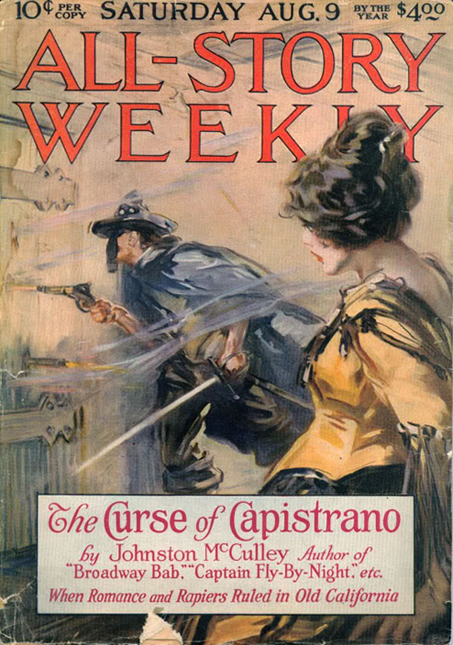
When I started writing, I wanted to do something reminiscent of the old pulp magazines. With that in mind, I'd like to talk about one of my favourite pulp tales; Johnston McCulley's The Curse of Capistrano, also known as The Mark of Zorro. First written in 1919 and serialised in All Story Weekly, it was the debut of the masked swashbuckler made popular by Antonio Banderas.

Most people know who Zorro is, but if you don't, here's a brief summary: Don Diego Vega is a Spanish nobleman living in California during the early 19th Century. To most people, he's a lazy fop who detests any form of physical activity. However, this is all a façade, as he secretly assumes the persona of Señor Zorro (Mr Fox), a masked swordsman who protects the oppressed while fighting corruption and injustice.

The original story follows Diego as he tries to win the heart of Lolita Pulida, the daughter of an impoverished noble, while she is attracted to Zorro. Also present is Captain Ramon, the local military commander, and his underling Sergeant Gonzales, a friend of Diego who is determined to find Zorro. On top of that, Zorro is often appearing to punish anybody in power who abuse others.

The story has plenty of swashbuckling action and heroics, along with a surprisingly tight ending. In fact, McCulley only intended to write one story. It was Douglas Fairbanks who popularised the story by starring in the 1920 silent film, The Mark of Zorro. The success brought Zorro into the popular culture, with McCulley writing more adventures between 1922 up until his death in 1958. While that was going on, his hero was appearing in numerous serials, TV shows, and more film adaptations, including a sound remake of the Douglas Fairbanks film in 1940, and the more well-known 1998 film, The Mask of Zorro. I saw that again recently, and it holds up really well.

Like most pulp characters, the continuity is very loose. The original stories take place during the period when California was part of Mexico, but some versions take place slightly earlier, when it was still under Spanish rule. Other versions of the story establish him as a legacy character. For example, the 1937 serial Zorro Rides Again takes place in a contemporary setting, with the persona assumed by Diego's great-grandson James Vega. The Republic serials are available on YouTube, and are quite entertaining. The two I recommend are Zorro Rides Again and Zorro's Fighting Legion.

While most of the other stories are quite hard to find, the original story is public domain, and available here: https://archive.org/details/markzorro

Thursday, 16 October 2014

Concerning Gamergate

I'm going to get into a lot of trouble for this, but I need to get it off my chest.

At this point, most people know what Gamergate is. If you don't here's a definition I made as a tweet: "A prolonged hate campaign against women in the video game industry posing as a call for ethics in journalism."

 OK, so this thing started out when an ex-boyfriend of indie developer Zoe Quinn was whinging about his past relationship and people took it too seriously. This was followed by a number of questions regarding the ethics of video game journalism, and whether developers and journalists from games websites were getting too friendly.

Well, I guess I need to discuss ethics. I feel there should be ethics in journalism as much as any other profession, such as accountancy. In accountancy, you have numerous professional bodies like the Association of Accounting Technicians, which has a published set of professional ethics that can be adhered to in a working environment. With that in mind, let's look at journalism. There isn't the same kind of professional body you would get in journalism that you'd get in accountancy that I'm aware of. So, if there isn't a professional body, it's harder to have a strict ethical guideline which can easily govern a journalist's work.

Now the ethics discussion is out out of the way, let's talk about the bulk of this entire affair. Since the aforementioned whinging, many women involved in the video games industry have been receiving no small amount of harassment, abusive messages, and threats of physical and sexual violence. On top of that, leaks of personal information have resulted in some having to leave their homes. The most notable targets of this disgusting campaign have been Zoe Quinn and Anita Sarkeesian, whose exploration of the role of women in video games had already been met with a gross sexist backlash.

At the time of writing, Miss Sarkeesian recently had to cancel a public appearance at the Utah State University following threats of a mass shooting and the venue's refusal to carry out adequate security measures due the state's legislation regarding firearms. Less than a week ago, I myself was forced to report a troll on Twitter for making threats, although Twitter is unlikely to pursue an investigation as I was not the target of this.

Let me get something clear. I have watched Anita's work and I actually like it. This doesn't mean I necessarily agree with all the content, but I believe that she brings up some valid points, and it lends an interesting perspective that I've never really thought about. And if you don't share that view, that's fine, but it's not an excuse for death threats, or branding someone a 'femenazi' or a 'Social Justice Warrior'. The levels people are going to fight what they perceive as changes to the status quo are beyond unacceptable. It's essentially terrorism. And the fact that Miss Sarkeesian cancelled a public appearance will be regarded as a victory by the perpetrators of this vile behaviour. I think I've established which side I've taken in the argument. But harassment of any kind must be condemned wherever it appears and whatever form it takes.

This bigoted crusade has to stop. Then we can discuss ethics like mature and responsible human beings can't we? And to anybody who has been a victim of these harassment campaigns: be strong, stay safe, and don't let the bastards grind you down.

Monday, 2 September 2013

5 Blood-Boiling Features of Retro Gaming

Recently, I've been playing a lot of old Super Nintendo titles that I grew up with, along with a few that I missed out on. On one hand, I enjoyed the memories of the fun challenge these games provided. On the other hand, I remember some of the blood-pressure inducing aspects that I found incredibly frustrating. So, I figured I might count down the five most annoying aspects of retro gaming. I'm referring specifically to the 16-bit consoles, but this could be applied to any generation.

5. Time Limits
I like to complete levels at my own pace, but if there's a time limit involved, that goes out of the window. Granted, I should take the time limit into account when I play, and the pressure does sometimes help, which is why I ranked this pretty low. Nonetheless, there's nothing worse than having to start a level again because I ran out of time - especially if it's a typical 'That One Level'.

4. Automatic Scrolling
Another feature which I think sometimes adds unwanted pressure. For those who don't know, this is when the levels is always scrolling, forcing you to move forward. This means that greener players will be trying to move ahead to avoid being scrolled into the wall, resulting in them being killed by the other hazards. I always used to really hate this kind of mechanic, especially if I keep missing a bonus.

3. Respawning Enemies
I don't know about anybody else, but I want to be able to make sure that I have a clear escape if I have to back-track. There's nothing worse than clearing out a room full of particularly tough enemies, only to have them come back when you re-enter the room.

2. Knockback
This appears a lot in games like Castlevania or Ninja Gaiden. I'm talking about when you get hit and you get knocked backwards. It's an evil addition to any platformer. Health bars become irrelevant when you end up falling down an abyss with every cheap hit. Castlevania IV tones this down, but it's still present and painful.

1. Wall Jumping
Feel free to tell me I'm a rubbish gamer, but I really hate wall jumping puzzles. I don't think I have the technique there. I've been stuck for ages on some puzzle in Super Metroid where some Ewok things are directing me to wall jump up a chasm. This is being played on an emulator with an Xbox 360 controller, and I keep morph-balling. This is the only real example I have, but it inspired me to make this list.

So there you have it: the things I'd rant about in gaming before they had DRM or Microtransactions. Please send comments detailing the parts that annoy you, or examples of the stuff here. I like to compare notes.

Welcome

Hi to whoever stumbles across this:

I'm a part time writer who creates short stories and serials, publishing online.

As you can probably guess, I named this place The Writer's Block because I have currently been down with a case of it. I figured that if I started my own blog, it may help me overcome it by getting into a better mindset.

You can find my published works in the link below:

http://www.scribd.com/andrew_roberts_66

Not much else to say, except to watch this space for anything further.

The Ezio Collection Revisited - Assassin's Creed: Revelations

Another week, another heatwave. It probably hits different in Turkey. Anyway, today I'm looking at the third and final entry in the Ezio...