Tuesday, 29 September 2015

James Bond Marathon: You Only Live Twice

Roald Dahl did the screenplay for this? Well, that is a surprise. Anyway, I'm trying to keep my nitpicking to a minimum for the duration of this marathon. But this film is making that really difficult.

But before I get to that, let me give you a summary. NASA's latest space mission is disrupted when a mysterious craft steals the capsule and the crew. Naturally, the Americans decide to blame the Russians, but a British diplomat suggests a Japanese involvement. Cut to Bond 'on the job' in Hong Kong when he gets killed before  the opening credits. After a public funeral, it's revealed that he faked his death to give himself some elbow room to investigate. Arriving in Japan, Bond works with the head of the Japanese secret service Tiger Tanaka, and girl of the week Aki, suspecting the involvement of the billionaire industrialist Mr Osato. However, it soon  transpires that Osato is involved with SPECTRE, which Bond figures out almost immediately. But considering their usual run of dastardly plots, I wouldn't be surprised either. Most notably, they finally give SPECTRE's Number 1 a face and a name; the criminal mastermind Ernst Stavro Blofeld, played by Donald Pleasence.

One thing I will say is that Aki may have been one of the most active Bond girls so far, saving Bond's skin several times. I enjoy the Japanese setting very much, and although I have doubts about some the ways it perceives Japanese culture (particularly regarding women). Especially when they decide that Bond must become Japanese. Yes, that is as cringe-inducing as it sounds.

Set pieces include Tanaka dispatching a car of goons by picking it up with a helicopter and dropping it in  the sea, a brawl with stevedores, a dogfight which makes use of Little Nellie, and a battle in SPECTRE's volcano lair involving ninjas. Despite the goofiness, Little Nellie was a nifty little toy, an autogyro equipped with an impressive arsenal.

I think that there are some parts of this one that are incredibly goofy and ridiculous, but I also think that it's actually done pretty well. Roald Dahl has managed to make this film so ridiculous it's awesome.

That's all I really have to say about it.

We'll meet again, Mr Bond, in On Her Majesty's Secret Service.

Monday, 28 September 2015

James Bond Marathon: Thunderball

Was SCUBA diving the biggest fad of 1965? Well, it doesn't matter if that's the case or not, because this Bond film's a pretty good one.

The cold open is great. Bond attends a funeral in Paris for a colonel in league with SPECTRE, but soon realises that the deceased is very much alive and posing as his widow. He trails him back to his château, kills him after a rough fight, and escapes his goons with a jetpack and his Aston Martin. James Bond with a jetpack. In 1965. That alone is worth a viewing.

Anyway, SPECTRE carries out a highly ambitious plot to steal two nuclear warheads from NATO, and hold them to ransom by threatening a major city in Britain or the USA. In response, MI6 mounts Operation Thunderball to recover them. Bond, who was on a rest period at a health clinic, is called in following an attempt on his life involving a spinal traction machine. After recognising a body at the clinic as a NATO commander, he travels to Nassau to find the man's sister Domino, the mistress of Emilio Largo, the SPECTRE agent behind the theft. Soon, the two are playing the deadly waltz of intrigue in the Bahamas.

I think about 40% of this film was shot underwater (let me know if I'm mistaken). The best set piece is the climax, featuring an underwater battle between SPECTRE divers and the US Navy aquaparas. Bond enters the fray this time with an underwater propulsion unit designed by Q. And taking place on the beach, there's plenty of fan service with both Connery and the girls of the week; Claudine Auger as Domino, and Luciana Paluzzi as the SPECTRE assassin and femme fatale Fiona Volpe. Adolfo Celi portrays Largo as a charming yet ruthless villain. He won't hesitate to execute those who fail him or attempt betrayal, preferably by feeding them to sharks. Not to mention he has a sweet boat, the Disco Volante.

Given the choice, I would rank this one quite highly. I especially like the opening song by Tom Jones. Rumours about his lung capacity aside, the lyrics being a summary of James Bond's character is a very nice touch.

Right, I'll see you next time. Over and out.

Sunday, 27 September 2015

James Bond Marathon: Goldfinger

TV Tropes refers to this film as "The one pop culture parodies the most." Well, it certainly does have some of the most memorable moments, but is it the best Bond film of all time? Light your torches and grab your pitchforks, because I don't really think so.

After a cold opening involving "heroin-flavoured bananas" and a shocking death, Bond is relaxing in Miami Beach when his old friend Felix Leiter assigns him a mission to observe Auric Goldfinger, played by Gert Frobe, who has been winning at gin rummy too much. Bond disrupts Goldfinger's scam, resulting in his assistant Jill Masterson being killed by being painted gold, even though the film's explanation would result in anybody who puts on a wetsuit suffocating. But I digress. Anyway, Bond is sent to determine whether or not Goldfinger is illegally transporting his gold across the continents, but soon learns of a scheme known as Operation Grand Slam - a plot by the Chinese government to irradiate the gold in Fort Knox, causing economic collapse in the West while boosting the value of Goldfinger's own bullion reserves.

Despite the comments at the beginning, I don't actually hate this movie. There are some really enjoyable things, like the gadget-equipped Aston Martin DB5 that Bond uses, Goldfinger's Korean manservant Oddjob and his steel-rimmed top hat, Honor Blackman as aloof girl of the week Pussy Galore, not to mention the scene with the laser that everybody knows. However, I find the film's biggest issue to be a glaring one: Bond is a bystander. He gets captured in the first act, then he doesn't really do much after talking his way out of getting sawn in half. Leiter and the cavalry defeat the villains in the climax, although Bond does kill Oddjob, and they're the ones who disable the bomb. I actually find myself more interested in following Goldfinger's plan. He seems to have more pragmatism than other villains, like when the plan goes wrong, he reveals a colonel's uniform under his coat and kills his Chinese contact to avoid detection.

I suppose the other issue is that after Goldfinger, the films did tend to get a bit formulaic. But I'll cross that bridge when I come to it.

I'll be back tomorrow when James Bond returns in Thunderball.


Hang on a minute. Did Bond just force himself on Pussy Galore? Christ, no wonder I was rooting for the bad guy.

James Bond Marathon: From Russia with Love

I like to compare this one to films like Aliens, or The Empire Strikes Back, in which the sequel is far superior to the first film.

Bond's new mission is to make contact with the girl of the week Tatiana Romanova, played by Daniella Bianchi. Romanova is a cipher clerk at the Russian consulate in Istanbul, who claims to have fallen in love with Bond's file photo, and is offering to defect with a highly sought after decoding machine used by the Russians. However, both are unaware that the defection is a scheme by the terrorist organisation SPECTRE, who seek revenge for the death of Dr No. SPECTRE's 'Number One' assigns the mission to Colonel Rosa Klebb, a former Soviet Intelligence officer played by Lotte Lenya, who manipulates Tatiana into thinking it is a mission to provide false intelligence to the British. Also recruited is the SPECTRE assassin Donald 'Red' Grant, played by Robert Shaw, whose mission is to monitor Bond until he acquires the decoder, then kill him and steal it so SPECTRE can sell it back to the Russians, thereby profiting from the revenge.

From Russia with Love sees the introduction of Desmond Llewellyn as Q, the MI6 inventor. Granted, Q had appeared in the previous film, played by Peter Burton, but was referred to as Major Boothroyd (named after a gunsmith who recommended the Walther PPK to Fleming), and all he ever issued was Bond's standard issue sidearm. This time around, he issues bond with an attaché case with a collapsible sniper rifle, a throwing knife. and a booby trap which detonates a tear gas cannister if opened incorrectly. Other gadgets include a watch with a concealed garrotte favoured by Grant, and a shoe with a poisoned toe-spike used by Klebb and a SPECTRE trainer (played by Walter Gottell, who would have a recurring role in the Moore films, but I'll get to that).

Set pieces include a brawl at Roma camp, a scuffle in a train car, and a boat chase. The action is kept down at first in favour of the espionage, but I have no problem with that. In fact, I think it works to the film's advantage.

The film's higher production value and more down-to-earth story and setting make this one of the best films of the Connery era, and one of my favourite films in the franchise.

I'll see you again soon for the next film.

Saturday, 26 September 2015

James Bond Marathon: Dr No

I have no idea why the powers that be opted to adapt the sixth book in the series as the first Bond film. It wasn't even the most recent book in 1962. Well, maybe it was because Ian Fleming lived in Jamaica when he was writing.

Anyway, the first Bond film in the main series, starring Sean Connery as the titular secret agent. Bond is sent on a mission to Jamaica to investigate the disappearance of the local MI6 Station Chief. Aided by Felix Leiter of the CIA and a local fisherman named Quarrel, his investigation takes him to the island of Crab Key, owned by the reclusive Bauxite magnate and scientist known only as 'Dr No', played by Joseph Wiseman. After enduring numerous assassination attempts, such as a poisonous spider being placed in his hotel room, and an attack by a dragon, Bond is soon captured along with the shell diver Honey Ryder, played by Ursula Andress. Brought before the mad doctor, he learns of his plot to disrupt the Mercury space flights by 'toppling' the craft's guidance system with an atomic-powered radio beam.

I've heard that this film's budget was only $1 million, and it does show; some of the effects look really cheap, even by 1962's standards. However, my biggest issue lies with the character of Honey Ryder. Yes, she looks pretty in her white bikini and she has a great (dubbed) singing voice. But she is an utter load who hinders more than helps. I mean, she blows Bond's cover by sailing to Crab Key, which means they get detected by a radar. Yes, she shows them to a hiding place, but she does nothing else. Other than that, the film is an enjoyable experience.

Dr No is actually one of the few James Bond novels that I have actually read, and the film certainly deviates from the book in many ways. But I'm not going to go into that; it's an adaptation, so you have to make changes for one reason or another.

Despite the cheapness, I'd say that the film-makers did a great job. Bond is suave and daring, and you want to see him win against the odds. Dr No is suitably sinister with his mechanical arms, and the first of many evil lairs is a great one, with his mythical dragon keeping visitors from snooping around.

Not much else to say. I'll see you next time for the next film.

Friday, 25 September 2015

The James Bond Marathon

"My name is Bond. James Bond."

That line has been drifting through popular culture for more than 50 years. And if you include the books, more than 60.

Ian Fleming's symbol of British exceptionalism has been the one of the longest-running film franchises, and one of the greatest movie heroes of all time. And I'd like to honour this by looking at his cinematic progression over six actors and 22 (soon to be 23) films.

Starting tomorrow, I am going to be watching my way through the series, and posting my views here.

With guns, girls, gadgets, flash cars, perilous situations, good guys, bad guys, and whatever other buzz words I can put here, it will be a James Bond Marathon that is sure to leave you shaken, but not stirred.

Thursday, 28 May 2015

The Goon Show

This is the BBC Home Service. Do you have a gorilla?

Today is the 64th anniversary of one my favourite radio comedies. I'm of course talking about the all leather Goon Show.

My late grandfather introduced me to this surreal comedy from the 1950s a while back. It has been in my mind ever since then. Initially starting out as a sketch comedy starring Harry Secombe, Spike Milligan, and Peter Sellers, it was later re-formatted into a sitcom with a recurring cast of principal characters.

Harry Secombe stars as the protagonist, an affable but gullible idiot named Neddie Seagoon. Meanwhile, Milligan and Sellers serve as a double act as the other characters: The world's greatest fool known simply as Eccles, East Finchley's long-suffering boy adventurer Bluebottle, the cowardly soldier Major Dennis Bloodnok, the doddering seniors Henry Crun and Minnie Bannnister, and the two main antagonists Hercules Grytpype-Thynne and Count Jim Moriarty. While the scenarios vary, the overall formula consists of Seagoon becoming a fall guy for the schemes of Grytpype and Moriarty, and meeting the other characters along the way.

As the opening sentence suggests, the show was built on surreal comedy, built on non-sequitur comebacks and sound effects. It's like a cartoon without any visuals, yet the musical interludes by Max Geldray and Ray Ellington give it the feeling of a variety show.

While there is the occasional joke that's a little offside by today's social standards, there is still a very timeless feel to the show. If you get the chance to hear some episodes, I recommend that you take it. They still make me laugh even today.

Saturday, 23 May 2015

Owd Grandad Piggott

Back in November 2014, I did my first public reading as part of an event held at the Gladstone Pottery Museum in Stoke-on-Trent. While looking for inspiration, I was somehow led to a seemingly long-lost icon of Stoke; The Owd Grandad Piggott stories of Alan Povey.

For those who don't know, these stories were performance pieces written by Povey, which he read out on BBC Radio Stoke in the Seventies. Taking place in Longton in the 1950s and told from the author's perspective,  they relate to the misadventures of his neighbour, the cantankerous pensioner known only as Owd Grandad Piggott.

The title character is no role model: He smokes, drinks to excess, is incredibly foul-mouthed, generally unkempt in his personal appearance, and always in trouble with the law. He's the kind of person you love to hate. It's always great to hear him getting his just desserts.

There are few other characters who appear throughout the stories. These include Nana Piggott, his long-suffering wife, the pub landlord Tommy Dawkins, and Club Paper Jack, the man who would do anything for money except work. He's kind of like Del Trotter in that regard. The author sometimes gets involved too, often to make snarky responses to Piggott's complaints.

So, what happened?

Well, it was difficult for Owd Grandad to get much fanfare outside of Stoke-on-Trent, mainly because the stories required a strong understanding of the local Potteries dialect. But he might be fading away within Stoke too, as fewer people can relate to growing up there during the 50s. On top of that, the running themes of domestic violence may not sit well with a modern audience.

I think it's a neat little series, if you can get your hands on it. A few of the stories are available on YouTube from this channel here: https://www.youtube.com/user/Rasputin63xxx/videos

They're worth a listen, if you can understand them.

Well, that's about it. I didn't really have much else to say. I'll see you next time.

Friday, 6 March 2015

It's About Ethics in Journalism

A while back, I wrote a very scathing blog post about the phenomenon most of know as GamerGate. Well, I'm a little calmer, and I consider myself to be more anti-harassment than anti-GamerGate.

And this debate...is not actually the subject of this post. Instead, I want to talk about a show I've recently come across; Drop the Dead Donkey.

I don't think many people have come across this 90s Britcom as much as others like Blackadder or Red Dwarf. Well, it's probably because it's based on the current affairs of the time so it could be considered 'dated'.

The setting is Globelink News, a news network which has recently been acquired by a business magnate named Rupert Murdoch Robert Maxwell Sir Roysten Merchant. What promptly follows is the conflict between the editor George Dent and the staff who want to maintain the station's reputation as a serious news programme, and the new Chief Executive Gus Hedges, who's after a more sensationalist style while making sure they don't report on anything that may damage Sir Roysten's business empire.

The show has some great characters. George Dent is by all accounts an ethical journalist, but he's also a nervous wreck who's afraid to stand up to Gus - a management stereotype of the worst kind. George's assistant editor Alex Pates acts as the voice of reason, but has a strong cynical streak and fierce temper. The station's news anchors are Henry Davenport and Sally Smedley. Henry is a veteran reporter contemptuous of everything in the modern news industry. He's also an alcoholic, gambler, and womaniser, along with the sub-editor Dave Charnley. Meanwhile, Sally is very snobbish and vapid, hand-picked by Gus. This makes her very unpopular with the rest of staff, especially Henry.

Last but not least, there's the 'star reporter' Damien Day. He gets some hilarious moments from his habit of making his stories as sensationalist as possible. He's not exactly ethical about it either, but George can't dismiss him because Gus likes him too much.

There is a lot of snarking between everybody, but the clashing personalities work off each other very well.

As mentioned above, the shows are based on the current events from the time of transmission, but the DVD releases always state the events on which they were based.

Now, you're probably wondering what this has to do with GamerGate. Well, I think that if you're interested in ethics in journalism, you should check the series out. Although by mentioning this, I've probably pulled off a Damien.

Thursday, 5 March 2015

A Post for World Book Day

So, today's World Book Day, and I've got a report looming over me like the anvil suspended over my head. Well, I have a moment, so I want to take the time to do a book review.

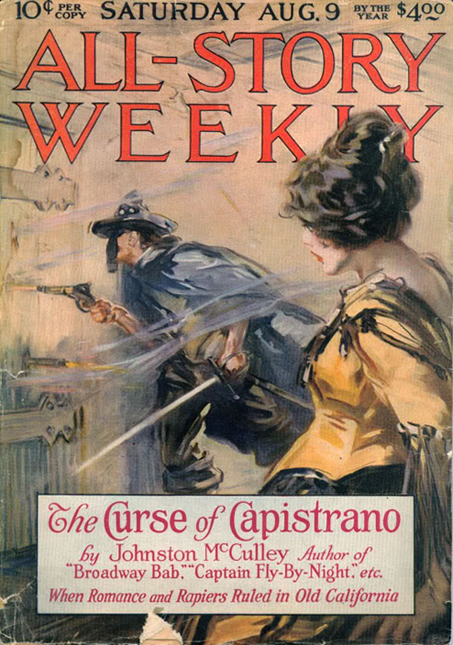
When I started writing, I wanted to do something reminiscent of the old pulp magazines. With that in mind, I'd like to talk about one of my favourite pulp tales; Johnston McCulley's The Curse of Capistrano, also known as The Mark of Zorro. First written in 1919 and serialised in All Story Weekly, it was the debut of the masked swashbuckler made popular by Antonio Banderas.

Most people know who Zorro is, but if you don't, here's a brief summary: Don Diego Vega is a Spanish nobleman living in California during the early 19th Century. To most people, he's a lazy fop who detests any form of physical activity. However, this is all a façade, as he secretly assumes the persona of Señor Zorro (Mr Fox), a masked swordsman who protects the oppressed while fighting corruption and injustice.

The original story follows Diego as he tries to win the heart of Lolita Pulida, the daughter of an impoverished noble, while she is attracted to Zorro. Also present is Captain Ramon, the local military commander, and his underling Sergeant Gonzales, a friend of Diego who is determined to find Zorro. On top of that, Zorro is often appearing to punish anybody in power who abuse others.

The story has plenty of swashbuckling action and heroics, along with a surprisingly tight ending. In fact, McCulley only intended to write one story. It was Douglas Fairbanks who popularised the story by starring in the 1920 silent film, The Mark of Zorro. The success brought Zorro into the popular culture, with McCulley writing more adventures between 1922 up until his death in 1958. While that was going on, his hero was appearing in numerous serials, TV shows, and more film adaptations, including a sound remake of the Douglas Fairbanks film in 1940, and the more well-known 1998 film, The Mask of Zorro. I saw that again recently, and it holds up really well.

Like most pulp characters, the continuity is very loose. The original stories take place during the period when California was part of Mexico, but some versions take place slightly earlier, when it was still under Spanish rule. Other versions of the story establish him as a legacy character. For example, the 1937 serial Zorro Rides Again takes place in a contemporary setting, with the persona assumed by Diego's great-grandson James Vega. The Republic serials are available on YouTube, and are quite entertaining. The two I recommend are Zorro Rides Again and Zorro's Fighting Legion.

While most of the other stories are quite hard to find, the original story is public domain, and available here: https://archive.org/details/markzorro

Thursday, 16 October 2014

Concerning Gamergate

I'm going to get into a lot of trouble for this, but I need to get it off my chest.

At this point, most people know what Gamergate is. If you don't here's a definition I made as a tweet: "A prolonged hate campaign against women in the video game industry posing as a call for ethics in journalism."

 OK, so this thing started out when an ex-boyfriend of indie developer Zoe Quinn was whinging about his past relationship and people took it too seriously. This was followed by a number of questions regarding the ethics of video game journalism, and whether developers and journalists from games websites were getting too friendly.

Well, I guess I need to discuss ethics. I feel there should be ethics in journalism as much as any other profession, such as accountancy. In accountancy, you have numerous professional bodies like the Association of Accounting Technicians, which has a published set of professional ethics that can be adhered to in a working environment. With that in mind, let's look at journalism. There isn't the same kind of professional body you would get in journalism that you'd get in accountancy that I'm aware of. So, if there isn't a professional body, it's harder to have a strict ethical guideline which can easily govern a journalist's work.

Now the ethics discussion is out out of the way, let's talk about the bulk of this entire affair. Since the aforementioned whinging, many women involved in the video games industry have been receiving no small amount of harassment, abusive messages, and threats of physical and sexual violence. On top of that, leaks of personal information have resulted in some having to leave their homes. The most notable targets of this disgusting campaign have been Zoe Quinn and Anita Sarkeesian, whose exploration of the role of women in video games had already been met with a gross sexist backlash.

At the time of writing, Miss Sarkeesian recently had to cancel a public appearance at the Utah State University following threats of a mass shooting and the venue's refusal to carry out adequate security measures due the state's legislation regarding firearms. Less than a week ago, I myself was forced to report a troll on Twitter for making threats, although Twitter is unlikely to pursue an investigation as I was not the target of this.

Let me get something clear. I have watched Anita's work and I actually like it. This doesn't mean I necessarily agree with all the content, but I believe that she brings up some valid points, and it lends an interesting perspective that I've never really thought about. And if you don't share that view, that's fine, but it's not an excuse for death threats, or branding someone a 'femenazi' or a 'Social Justice Warrior'. The levels people are going to fight what they perceive as changes to the status quo are beyond unacceptable. It's essentially terrorism. And the fact that Miss Sarkeesian cancelled a public appearance will be regarded as a victory by the perpetrators of this vile behaviour. I think I've established which side I've taken in the argument. But harassment of any kind must be condemned wherever it appears and whatever form it takes.

This bigoted crusade has to stop. Then we can discuss ethics like mature and responsible human beings can't we? And to anybody who has been a victim of these harassment campaigns: be strong, stay safe, and don't let the bastards grind you down.

The Ezio Collection Revisited - Assassin's Creed: Revelations

Another week, another heatwave. It probably hits different in Turkey. Anyway, today I'm looking at the third and final entry in the Ezio...